
Emulating f64 in shaders · Part 1 of 10
Emulated double precision in the shader DSL
f64 and vecN<f64> as first-class shader-dsl types, emulated as two-f32 double-float pairs — same authoring syntax as f32, one lowering pass, ~48 significand bits.
By the X-GIS team 6 min read
At a world coordinate near , f32’s spacing is :
every sub-integer detail is unrepresentable. GPUs offer no f64 (WGSL has
none; GLSL ES never did), so map engines accumulate hand-rolled hi/lo
workarounds — relative-to-center encoding, DSFUN lane packing. Those hold
while the precision only has to survive into a coordinate: recenter once on
the CPU, render f32 offsets. They break the moment the coordinate feeds
iterated nonlinear arithmetic — the fp64 Mandelbrot below squares
hundreds of times per pixel, and a once-recentered offset
loses its tail on the first squaring. That is when you need precision carried
through the operations, which is a general df64 type, not a coordinate
trick.
@xgis/shader-dsl now has the general mechanism: first-class f64 and
vec2/3/4<f64> types, emulated as double-float (df64) pairs of f32s,
~48 significand bits. The design constraint: authoring syntax is identical
to f32 — only the declared type differs.
const U = uniformStruct( 'U', { group: 0, binding: 0, as: 'u' }, { origin: vec3f64T, // ← the only fp64-specific line in the module scale: f64T, },)const k = fn('k', { p: vec3f64T }, (args) => toF32(length(args.p.sub(U.field.origin).mul(U.field.scale))),)Representation
An f64 value is an unevaluated sum of two floats,
carried as a vec2<f32>. Arithmetic uses error-free transformations (EFTs):
Knuth’s 2Sum [2], Dekker’s Fast2Sum and the Veltkamp split [1] (×4097 —
FMA-based twoProd is deliberately avoided; WGSL fma() accuracy is only
“inherited from x*y+z”). 2Sum is the archetype: for any floats ,
with the error recovered by six ordinary additions — the same expansion
machinery behind Shewchuk’s robust geometric predicates [3] and the
double-double/quad-double libraries [4]. Division and square root use an f32
seed plus one Newton–Raphson correction, following luma.gl’s formulation [7].
The GPU lineage runs DSFUN90 [5] → the NVIDIA CUDA SDK Mandelbrot sample’s
dsadd/dsmul [6] → Thall’s df64/qf128 paper [8] → luma.gl [7].
One lowering pass
All f64 semantics live in a single pre-emit pass, fp64Lower, wired into the
shared backend pipeline so WGSL and GLSL lower identically and the optimizer
only ever sees ordinary IR plus opaque df64_* calls:
f64→vec2<f32>; literals split losslessly at build time (a JS number is an f64)vecN<f64>→struct DF64VecN { hi: vecN<f32>, lo: vecN<f32> }; componentwise+ − × ÷run the same EFTs on whole hi/lo planesabs/min/max/mix/floor/fract/normalizeon vectors compose the verified scalar helpers lane by lane inside one helper body;dot/length/distanceaccumulate through the scalar df64 chain- f32 widens implicitly (exact); narrowing is explicit
toF32(x)only; every unsupported builtin on an f64 operand fails loud (SD0041) - a module with no f64 passes through as the same object — non-f64 emit bytes are unchanged by construction
The anti-fast-math guard
The EFT error terms are algebraically zero, and the WGSL specification
explicitly permits implementations to reassociate and fuse floating-point
operations [9][10] — a legal transformation that deletes the whole mechanism.
The lowering therefore threads a runtime-opaque one (value 1.0) through
every error-compensation term — luma.gl’s
LUMA_FP64_CODE_ELIMINATION_WORKAROUND [7] — and injects its source
automatically: a 1×1 texture bound as _fp64. The emitted 2Sum shows the
shape (the fetch is CSE-hoisted once per helper body):
fn df64_twoSum(a: f32, b: f32) -> vec2<f32> { let _cse0 = textureLoad(_fp64, vec2<i32>(0, 0), 0).x; let _v0 = (a + b); let _v1 = (((_v0 * _cse0) - a) * _cse0); let _v2 = (((((a - ((_v0 - _v1) * _cse0)) * _cse0) * _cse0) * _cse0) + (b - _v1)); return vec2<f32>(_v0, _v2);}A texel is the strongest opacity WebGL offers: a uniform’s value is visible to
the pipeline compiler and can be specialized on, whereas current WebGL2/WebGPU
stacks never fold texture contents into a compile-time constant. A
uniform-sourced guard is therefore defeated by drivers that specialize
pipelines on observed uniform values, which we learned from a production bug
report —
the incident write-up covers
that investigation. Hosts bind a texture whose texel reads exactly 1.0;
fp64Guard({ group, binding }) pins the slot when a fixed bind-group layout
requires it.
Layout and host surface
- An f64 uniform field or vertex attribute occupies its lowered
vec2<f32>slot ({size 8, align 8}); vec64 fields use their struct’s std140/std430 layout through the same layout engine, so authored and loweredreflect()agree byte-for-byte. - Hosts pack values with the exported
splitF64(x) = [hi, lo]. - f64 varyings are rejected (
SD0044) — interpolating hi/lo pairs is numerically wrong. A vec64 vertex attribute is rejected with a two-@location+f64FromPartshint (the existing DSFUN lane convention).
The demos

fp64 deep zoom: a world coordinate
near as fract() stripes — f32 (left) renders flat, f64 (right) keeps
the stripes.
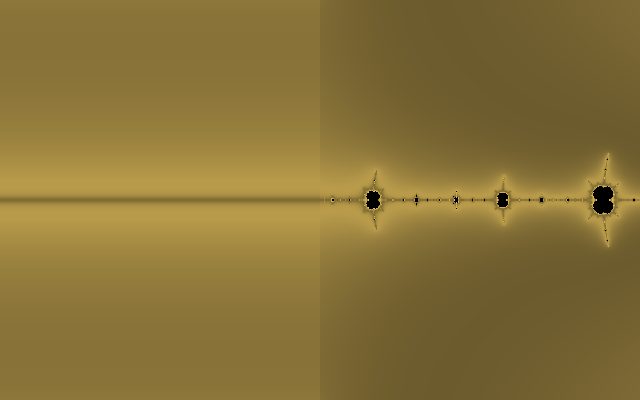
fp64 Mandelbrot: a needle-spike
filament at a span — narrower than one f32 ulp at
. Drag to pan, wheel to zoom (the camera accumulates in
JS doubles and lands in the vec2<f64> center uniform via splitF64), and
an fp64 toggle routes the whole screen through the f32 branch for a direct
A/B.
Scope and cost
Supported today: + − × ÷, comparisons, neg, abs, min, max, sqrt,
mix (f32 interpolant), floor, fract, and on vectors additionally
dot, length, distance, normalize. Transcendentals and two-slot vec64
attributes are deferred and fail loud. Each df64 op expands to a chain of these
EFTs — an add to two 2Sums plus two renormalizing quick-2Sums, a multiply to a
two-Veltkamp-split 2Prod plus its cross terms — so the emitted body is on the
order of a few dozen f32 ops, and the helpers stay out-of-line calls (they are
never inlined, by design). Roughly an order of magnitude over the f32
counterpart: opt in per value, not per shader.
How a numeric type like this gets tested without native f64 on the GPU or native f32 on the CPU is its own topic: Testing emulated doubles.
References
- T. J. Dekker, “A Floating-Point Technique for Extending the Available Precision,” Numerische Mathematik 18 (1971), 224–242 — Fast2Sum, the split, and double-length arithmetic.
- D. E. Knuth, The Art of Computer Programming, Vol. 2: Seminumerical Algorithms, §4.2.2 — the 2Sum algorithm.
- J. R. Shewchuk, “Adaptive Precision Floating-Point Arithmetic and Fast Robust Geometric Predicates,” Discrete & Computational Geometry 18 (1997), 305–363.
- Y. Hida, X. S. Li, D. H. Bailey, “Algorithms for Quad-Double Precision Floating Point Arithmetic,” Proc. ARITH-15 (2001), 155–162.
- D. H. Bailey, DSFUN90: a double-single floating-point package.
- NVIDIA, CUDA Samples — Mandelbrot
(
dsadd/dsmul, the original GPU double-single port). - luma.gl, fp64 shader module
— GLSL df64 with the
ONE-threading code-elimination workaround. - A. Thall, “Extended-Precision Floating-Point Numbers for GPU Computation” (2006) — df64/qf128 on graphics hardware.
- W3C, WebGPU Shading Language — Reassociation and fusion.
- gpuweb/gpuweb, issue #2402: “reassociation is always allowed”.
Read next
shader-dsl
6 min read
Your bundler minifies everything except your shaders
Emitted WGSL/GLSL ships to gl.shaderSource with its authored vocabulary intact — no JS minifier reaches it. A Vite/Webpack-style emit-plugin pass (mangle + minify) that compacts and obfuscates the shader text, the ABI boundary it must never cross, and why compile-and-link is not enough to trust it.
compiler
6 min read
The .xgis compiler pipeline: from style text to GPU programs
How a declarative map style becomes GPU work: lexer → parser → a Scene IR → optimization passes → codegen that emits typed shader-dsl IR (never WGSL strings), per-feature compute kernels for match(), and a gradient atlas for zoom-dependent paint.
precision
6 min read
The precision fix that opened a seam
Making the line outline's projection precise, but not its polygon fill, turned a shared invisible jitter into a ~3px fill≠outline seam at deep zoom. The fix isn't more f64 — it's the same camera-relative reframe, which the linear term needs no emulation for.